Benchmarking: Bond - Esperanza: Difference between revisions
No edit summary |
No edit summary |
||
| (3 intermediate revisions by the same user not shown) | |||
| Line 11: | Line 11: | ||
* A×b of Esperanza ore (Aug-Dec 2012); avg= 39; range is 30.7 to 45.5. |
* A×b of Esperanza ore (Aug-Dec 2012); avg= 39; range is 30.7 to 45.5. |
||
* Wi<sub>BM</sub> average is 16.0 kWh/st, = 17.6 kWh/tonne. |
* Wi<sub>BM</sub> average is 16.0 kWh/st, = 17.6 kWh/tonne. |
||
* E<sub>SAG</sub> for "normal" blasting, average = 5. |
* E<sub>SAG</sub> for "normal" blasting, average = 5.5 kWh/tonne; range is 3.9 to 7.2 kWh/tonne. |
||
* E<sub>SAG</sub> for "high intensity" blasting typically 10% lower E<sub>SAG</sub>. |
* E<sub>SAG</sub> for "high intensity" blasting typically 10% lower E<sub>SAG</sub>. |
||
* SAG feed size range 33.6% to 49.0 percent passing 1¼ inch (32 mm). |
* SAG feed size range 33.6% to 49.0 percent passing 1¼ inch (32 mm). |
||
A relationship for E<sub>SAG</sub> (as kWh/tonne) to A×b is given for Esperanza operating data: |
|||
<math>E_{SAG} = 22,548 (A \times b)^{-0.356} </math> |
|||
Design criteria for expansion cases (which may reflect Esperanza operating conditions) |
Design criteria for expansion cases (which may reflect Esperanza operating conditions) |
||
| Line 35: | Line 31: | ||
==Modelling== |
==Modelling== |
||
The Bond/Barratt SABC-B model is used with the default 10% E<sub>ssbm</sub> calibration factor. |
|||
* circuit F<sub>80</sub> = 132 mm |
|||
* circuit P<sub>80</sub> = 180 µm |
|||
* The average ball mill work index given as 16 kWh/short ton = 17.6 kWh/tonne |
|||
* The relationship between A×b and Wi<sub>RM</sub> for Andean copper porphyries can be used to determine the following rod mill work index values. |
|||
** A×b of Esperanza ore; avg= 39; becomes Wi<sub>RM</sub>=14.5 kWh/tonne |
|||
* No crushing work index is given. Assume a value of 12 kWh/tonne (slightly higher than typical porphyry) |
|||
* No ore density is given. Assume similar to Los Bronces, density=2.64 t/m³ |
|||
SAG mill is modelled using following: |
SAG mill is modelled using following: |
||
| Line 49: | Line 54: | ||
* assume 6 inch liner effective thickness, mill speed 75% of critical |
* assume 6 inch liner effective thickness, mill speed 75% of critical |
||
* total filling 30% v/v gives the desired 95% utilization of motor power |
* total filling 30% v/v gives the desired 95% utilization of motor power |
||
<gallery> |
|||
File:Twcompare_axb_vs_wirm.svg|Published A×b and Wi<sub>RM</sub> results for Andean porphyries |
|||
File:Screengrab_EsperanzaSAG.png|Model configuration for benchmarking |
|||
File:Screengrab_EsperanzaBM.png|Model configuration for benchmarking |
|||
File:Screengrab_EsperanzaAvgOre.png|Esperanza benchmarking circuit model screen grab |
|||
</gallery> |
|||
== Results == |
|||
Only one ball mill work index is provided, claimed to be the 'average'. The predictions of the min/max range are dubious because the ball mill work index should change between hard and soft ore. |
|||
{|class="wikitable" border="1" |
|||
! !! Average ore |
|||
|- |
|||
| Measured SAG specific energy consumption, kWh/t |
|||
| style="text-align:center"| 5.5 |
|||
|- |
|||
| Predicted SAG specific energy consumption, kWh/t |
|||
| style='text-align:center' | 5.9 |
|||
|- |
|||
| Difference, kWh/t |
|||
| style='text-align:center'| 0.4 |
|||
|- |
|||
| Difference, % |
|||
| style='text-align:center'| model predicts 7% high |
|||
|} |
|||
Latest revision as of 23:42, 9 January 2015
Benchmarking: Bond/Barratt SAG Mill Specific Energy Consumption - Esperanza
- Villanueva, F. and Soto, L., SEC and the impact on a mills selection for DMC project. Proceedings of the XXVII International Mineral Processing Congress, October 2014, Santiago, Chile. C14-23.
Paper describes modelling of two expansion cases (Esperanza Sur and Encuentro). Some operating data for the current Esperanza pit & plant are provided as they were used to tune the comminution models used for the expansion cases.
Design Criteria
Actual operating data from Esperanza
- A×b of Esperanza ore (Aug-Dec 2012); avg= 39; range is 30.7 to 45.5.
- WiBM average is 16.0 kWh/st, = 17.6 kWh/tonne.
- ESAG for "normal" blasting, average = 5.5 kWh/tonne; range is 3.9 to 7.2 kWh/tonne.
- ESAG for "high intensity" blasting typically 10% lower ESAG.
- SAG feed size range 33.6% to 49.0 percent passing 1¼ inch (32 mm).
Design criteria for expansion cases (which may reflect Esperanza operating conditions)
- SAG circuit F80 = 132 mm
- transfer T80 = 3500 µm (text erroneously says "3500 mm")
- BM circuit P80 = 180 µm
- SAG mill power utilization = 92.3%
- Ball mill power utilization = 95%
- Plant availability = 93%
Mill criteria
- SAG mill: 40 foot nom dia by 26 foot flange-to-flange cylinder length
- ball mill: 27 foot nom dia by 45 foot flange-to-flange cylinder length (2 units)
- SAG mill gearless motor 31,500 HP (given in Thiele & Parraguez, Relpas 2011 conference)
- Ball mill gearless motors 25,000 HP
(some references give 30,000 HP for SAG motor; this is thought to be the value excluding a 5% design margin)
Modelling
The Bond/Barratt SABC-B model is used with the default 10% Essbm calibration factor.
- circuit F80 = 132 mm
- circuit P80 = 180 µm
- The average ball mill work index given as 16 kWh/short ton = 17.6 kWh/tonne
- The relationship between A×b and WiRM for Andean copper porphyries can be used to determine the following rod mill work index values.
- A×b of Esperanza ore; avg= 39; becomes WiRM=14.5 kWh/tonne
- No crushing work index is given. Assume a value of 12 kWh/tonne (slightly higher than typical porphyry)
- No ore density is given. Assume similar to Los Bronces, density=2.64 t/m³
SAG mill is modelled using following:
- Austin model
- assume ore density 2.64 t/m³, same as Los Bronces
- nominal diameter 40 foot, effective grinding length 26 foot (deduct 2 ft from cylinder length)
- assume 6 inch liner effective thickness, mill speed 75% of critical
- ball charge 16% v/v; total filling 26% v/v gives the desired 92.4% utilization of motor power
Ball mill is modelled using following:
- Nordberg wet overflow model
- assume ore density 2.64 t/m³, same as Los Bronces
- nominal diameter 27 foot, effective grinding length 44.5 foot (deduct 6 inches from cylinder length)
- assume 6 inch liner effective thickness, mill speed 75% of critical
- total filling 30% v/v gives the desired 95% utilization of motor power
-
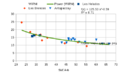 Published A×b and WiRM results for Andean porphyries
 -
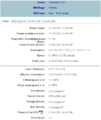 Model configuration for benchmarking
 -
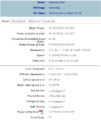 Model configuration for benchmarking
 -
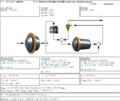 Esperanza benchmarking circuit model screen grab


Results
Only one ball mill work index is provided, claimed to be the 'average'. The predictions of the min/max range are dubious because the ball mill work index should change between hard and soft ore.
| Average ore | |
|---|---|
| Measured SAG specific energy consumption, kWh/t | 5.5 |
| Predicted SAG specific energy consumption, kWh/t | 5.9 |
| Difference, kWh/t | 0.4 |
| Difference, % | model predicts 7% high |